

You can appear for more local searches and still make the business harder to run.
The new calls may come from outside your service area. They may be for jobs you no longer take. Or they may fill the schedule with work that leaves too little room for the customers you actually want.
A useful local search strategy starts earlier than the ranking report. It decides which demand is worth pursuing, where you can serve it well, and what evidence will help those customers choose you. That is what “dominate local search” should mean for a working business.
Choose the market before choosing the keywords
Define the combination of service, customer, and geography you want to develop. A broad phrase such as “more leads in Houston” leaves too many decisions unresolved.
Start with the work you want more of. Look at the scope, delivery effort, travel, scheduling demands, and the likelihood of repeat business. Then identify who buys it and what they need to know before contacting you.
For an illustrative home-service business, planned replacement work may require a different message from emergency repairs. One customer needs reassurance about speed and availability; the other may need a careful comparison of options. The same homepage headline will not necessarily do both jobs well.
Write one clear priority for the next phase. You can expand later. A priority is useful because it helps you decline attractive-looking work that does not advance the chosen goal.
Read the map as evidence about a place
Google describes local rankings through relevance, distance, and prominence. Its local ranking guidance makes clear why a result seen at one location cannot describe every customer’s experience.
Check the searches that matter from the places where you want customers. Keep the query and measurement method consistent when comparing results. A local ranking grid can help show geographic variation, but its value depends on the locations and searches selected.
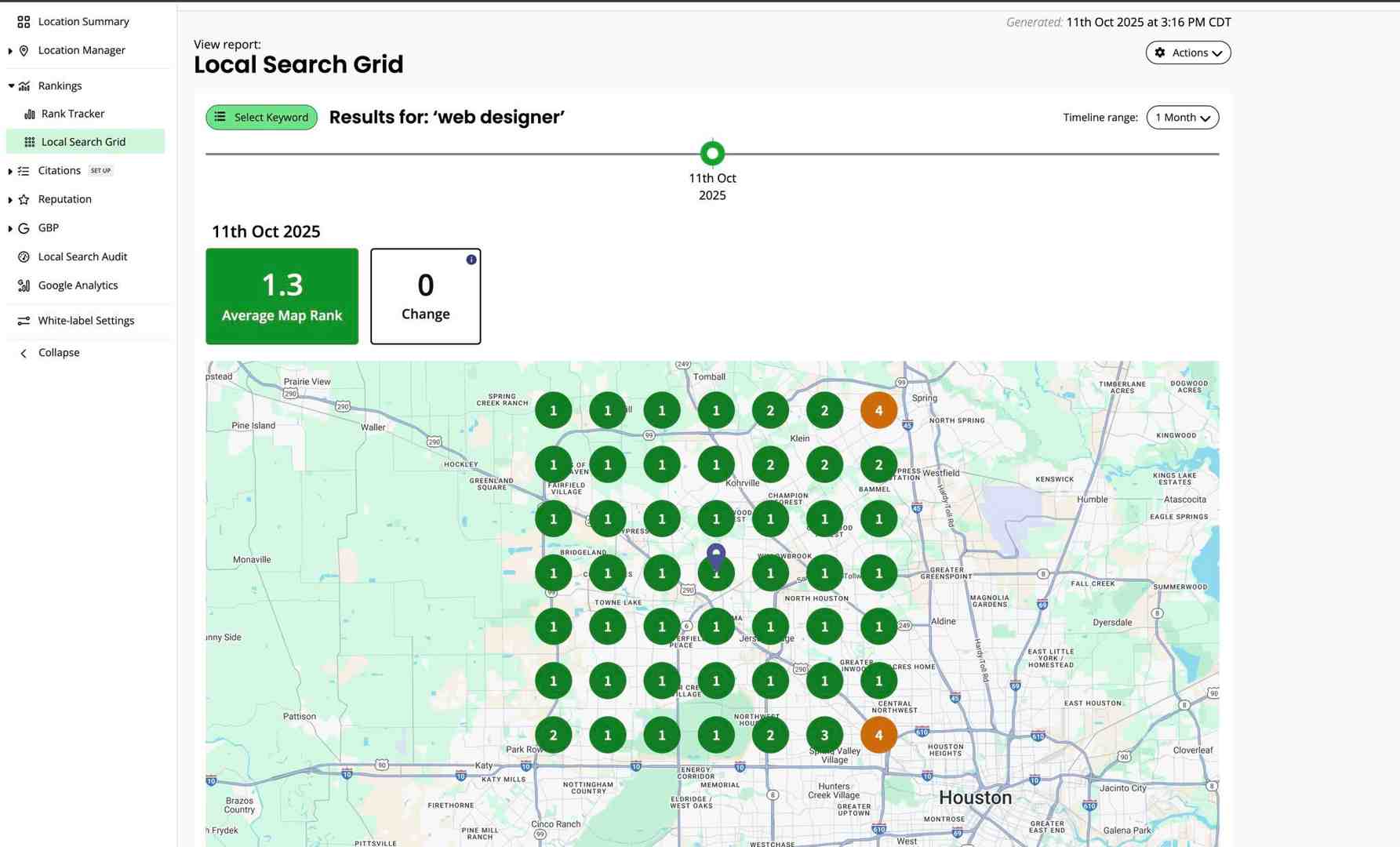
The historical grid above illustrates that kind of geographic reporting. It does not tell you which inquiries were qualified, what revenue followed, or how the same search performs today. Those require separate evidence.
Use a map to form a question. If visibility weakens in a priority area, investigate the offer, local competition, available proof, and the actual location relationship. Do not jump from a weak grid cell to a promise that another page will fix it.
Choose coverage your operations can support
A service area is a business commitment before it is a marketing target. Ask whether travel, staffing, opening hours, delivery, and follow-up make the area practical to serve.
If a company wants more work in Katy, its Katy search strategy should reflect the services it can deliver there. A company concentrating on Cypress should make the same decisions before investing in Cypress SEO. The area name is the beginning of the brief.
Consider the cost of a successful campaign. Could the team accept the inquiries if the plan worked? Would responding in that area interfere with existing customers? Marketing and operations should agree on the answer before the site promises availability.
Where coverage is limited, say so clearly. A smaller, accurate footprint is easier for a prospect to understand than a long list of places that turns into a qualification problem on the phone.
Identify the weakest part of the customer journey
Follow one prospective customer from discovery through contact. There are several places the journey can break, and each suggests a different priority.
- They do not encounter the business: investigate relevant visibility, listing accuracy, and whether the website has a useful destination for that need.
- They find it but cannot assess it: improve the offer, scope, proof, and information about the next step.
- They want to inquire but cannot: repair forms, phone links, booking tools, and routing.
- They inquire but do not progress: review fit, response time, estimating, and follow-up with the people handling the work.
Choose the bottleneck you can support with evidence. A local SEO program should connect to that diagnosis. If the obstacle is an unclear or difficult website, web design work may need to happen alongside visibility improvements.
Build proof around the buying decision
Customers need a reason to believe the business can handle their situation. Choose evidence that answers the uncertainty, rather than collecting trust symbols because a template has space for them.
A project account can show the problem, scope, process, and documented outcome. Photographs can show actual work. An accurate explanation can help a buyer understand a trade-off. A genuine review can describe an experience, within the limits of that customer's account.
Put relevant evidence near the claim it supports. If the page explains a specialist service, show proof related to that service. If it describes area coverage, explain what that coverage means in practice.
Do not stretch an isolated success into a normal result. State the context of a case study and avoid implying that a ranking screenshot demonstrates revenue growth.
_compressed.jpeg)
The historical report above separates ranking movement from local-pack coverage. Even within one report, the measures describe different things. Use reports to investigate performance, then connect them with inquiry and customer records before making a commercial claim.
Make content answer the questions that block action
A local strategy does not require a blog about every nearby landmark. It requires enough useful information for the right customers to make progress.
Listen for questions that repeat during estimates, consultations, or support conversations. Does the buyer misunderstand the scope? Are they unsure which option fits? Do they need to prepare something before an appointment? Those are candidates for clear pages or articles.
Connect the answer to the relevant service with a natural internal link. A reader who has just learned how to compare two options should be able to find the service that helps them act on that knowledge.
Our content marketing services support that research and writing work. The useful unit is a resolved customer question, not a monthly quota of words.

Build relationships that exist beyond a link report
Look at the genuine relationships around the business: suppliers, professional associations, local organizations, complementary providers, and publications serving the same audience.
Some relationships may lead to accurate listings, useful resources, introductions, or editorial mentions. Choose them because the audience and contribution make sense. A placement should be explainable without referring only to an SEO metric.
Keep paid promotion transparent and separate from claims of independent endorsement. Google’s spam policies address link manipulation; buying ranking credit is a different proposition from buying legitimate advertising.
Decide how you will judge the next phase
Set a small group of measures around the chosen market. Include work completed, relevant visibility, qualified inquiries, and progress toward a sale or booking where available.
Use the same definitions over time. An inquiry from outside the coverage area should not become a qualified lead merely because it arrived through a channel you are trying to justify. A call-button click should not become a booked appointment in a summary report.
Agree on a review date and the decisions available at that point. You might continue a promising focus, improve a weak page, change the target, or stop an activity that is not supporting the goal. The review is useful when it changes a decision.
Expand from a working plan
Once you understand the demand, the customer path, and the delivery capacity for one priority, use what you learned to choose the next. Expansion might mean another service, another area, or better coverage of the same customer need.
For the implementation steps, use our Houston local SEO playbook. Begin with one service and one area you can serve well. Build the information and proof those customers need, then let the results guide the next investment.
.svg)
.avif)
FAQs
Common questions about our web design and SEO services in Houston.
What does it mean to dominate local search?
For a business, the useful aim is dependable visibility for the services and areas it wants to serve, supported by information that helps the right customers choose it. Broad rankings have limited value when they generate unsuitable inquiries or demand the business cannot handle.
Should I target the whole Houston metro at once?
Choose coverage based on actual services, capacity, travel, and customer demand. Concentrating on a clear priority makes it easier to assess what worked. Expand when the business can support the demand and the website has useful information for the additional area.
Are local ranking grids useful?
They can show how visibility varies across sampled locations for a particular search. Keep queries and methods consistent, and note the date. A grid does not measure qualified inquiries or sales, so use it alongside business records rather than as a complete performance report.
What should I improve before publishing more local content?
Trace the customer journey. Check whether the business can be found for the relevant need, whether the page explains the offer and proof, and whether the inquiry process works. Fix the best-supported obstacle before adding pages merely to increase output.
How do I choose the next area to target?
Assess whether the work is commercially useful, whether the team can deliver it reliably, what demand exists, and what relevant evidence the business can show. Set a focused scope and review the resulting inquiries before committing to broader expansion.
Still have questions?
We're happy to answer any additional questions you might have.
.avif)
.avif)
More from our blog
Explore more insights on web design, SEO, and digital marketing.



.avif)

Ready to build something better?
Let's talk about your project and how we can help your business grow online.
.avif)