.avif)


.svg)
The Complete Guide to Web Design Basics
Why Your Website Is Your Most Important Business Asset
Web design is the process of creating websites that build trust, generate leads, and represent your business with the professionalism it deserves. It combines visual design, user experience, technical performance, and content strategy into a single asset that works for your business around the clock.
What You Need to Know About Web Design:
- Visual Design (UI) - The aesthetics, typography, color, and layout that create instant credibility
- User Experience (UX) - The intuitive navigation and logical flow that guides visitors to action
- Content Strategy - The messaging and information architecture that demonstrates your expertise
- Technical Foundation - The code, speed, and structure that determine performance and search visibility
- Responsive Design - The mobile-first approach that ensures your site works on every device
- SEO Integration - The structural decisions that make your site findable in search results
Your website is the first place a prospect looks after hearing your name. It's your digital handshake. Most business owners treat it like a brochure. Something that exists because it has to. But your website should function as your most effective business development tool.
The problem is that most websites are built on unstable platforms. They break constantly, load slowly, and fail to rank in search results. You've probably experienced this yourself. Plugins that stop working. Security vulnerabilities. A developer who holds your site hostage. A beautiful design that no one can find on Google.
This happens because web design is treated as a one-time project instead of a strategic asset. The platform matters. The performance matters. The structure matters. When these fundamentals are wrong, no amount of visual polish will generate leads or build credibility.
I'm Wael Esmair, founder of Nimbus Media. I've spent the last five years building high-performance Webflow sites for professional services firms who are tired of the WordPress cycle and ready for a website that actually works. This guide will show you what separates a revenue-generating web design from a digital liability.
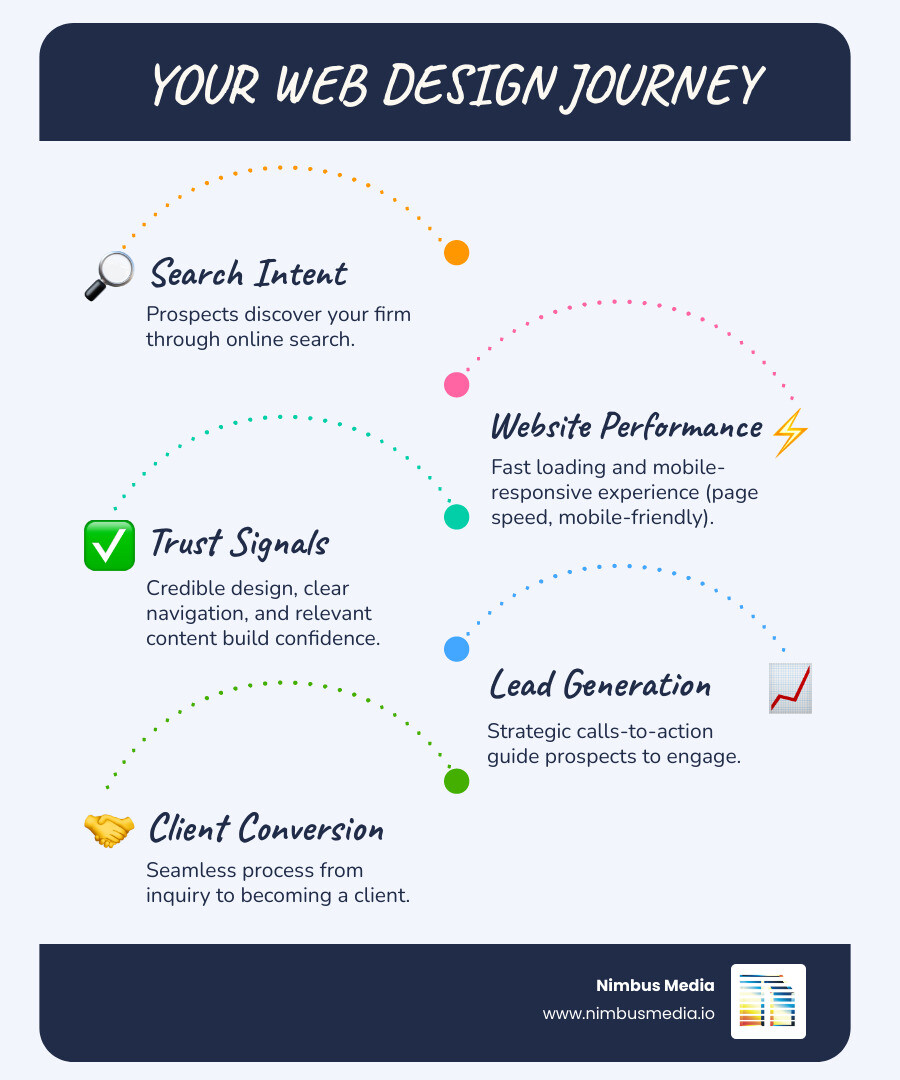
The Core Components: More Than Just Pixels
Strategy becomes visible here. A great website is built on a foundation of clear thinking about your user and your business goals.
Visual Design and User Interface (UI)
Aesthetics build instant credibility. Your firm's website is often the first visual representation a prospect encounters. Research indicates users form an opinion about a webpage in just 50 milliseconds. That's less time than it takes to blink. This initial impression is largely driven by visual design.
Visual design encompasses everything from your brand's color palette and typography to the overall layout and imagery. It's the suit your website wears to a client meeting. A professional UI shows you respect the user's attention, signaling competence and attention to detail. It creates a visual hierarchy that intuitively guides the eye, ensuring that key information stands out.
User Experience (UX) Design
How the site feels to use. Once a prospect is past the initial visual impression, their journey through your site determines whether they stay or leave. User experience (UX) design is the art of crafting that journey to be seamless and intuitive. It's about removing friction between a visitor's question and your answer.
Good UX means easy-to-understand navigation, logical information flow, and clear pathways to relevant content like case studies or contact forms. User understanding of your content often depends on their understanding of how your website works. Every interaction, every click, and every scroll should contribute to a positive, productive experience for your potential clients in Houston, Cypress, or Tomball.
Content and Information Architecture
What you say and how you organize it. Your website is where your expertise, your insights, and your unique value proposition come to life. But even the most brilliant content fails if it's buried or presented poorly. This is where content strategy and information architecture come in.
Information architecture is the discipline of organizing information clearly and logically for your visitors. We structure your content to guide users directly to the information they need to make an informed decision. Your case studies, service descriptions, and thought leadership pieces are organized for clarity. This involves chunking content into digestible segments, using clear headings, and ensuring that sentences are concise. Your expertise, structured, becomes a powerful tool for client conversion.
How Web Design Decisions Impact Your Business
Every design choice is a business decision. It either builds trust and generates leads, or it creates friction and loses them.
Building Credibility and Trust
Your website's design is a proxy for your firm's quality. In the professional services world, credibility is paramount. A clean, organized, and fast website signals competence, reliability, and attention to detail. It tells a prospect that you operate with the same level of precision in your digital presence as you do in your client work.
Conversely, a cluttered, slow, or broken site signals the opposite. It erodes trust before a conversation even begins. Savvy brands know a well-designed website builds trust with their target audience. This is why we engineer websites that don't just look good, but actively build confidence in your firm. Learn more about our approach to Web Design Services.
Generating Qualified Leads
A website's job is to attract the right prospects and filter out the wrong ones. Your website should be your most effective business development tool. It works 24/7, tirelessly qualifying and nurturing potential clients. Without a clear call-to-action (CTA), even the best-designed website won't convert visitors into customers.
We design strategic calls-to-action that are visible, action-oriented, and urgent. We create clear contact pathways and implement gated content for high-value resources. A digital brochure is a static cost. A revenue-generating website is an asset that drives qualified prospects to your firm in Houston, Katy, or Magnolia. Find how we can transform your website into a lead-generating machine with our Lead Generation strategies.
Communicating Your Unique Value
Your website is your first impression. In a crowded market, differentiation is key. Strategic design tells your story visually. It communicates your unique value proposition before a prospect ever reads a word. It's about integrating your brand's visual elements. Your colors, logo, and typography create a consistent and authentic digital representation of your firm.
We ensure your website seamlessly integrates your brand's visual elements, creating a cohesive and memorable online presence. This visual storytelling helps you stand out. It makes it easier for prospects to understand what makes your firm different and why they should choose you. Take a look at how we've helped other businesses tell their story through our Portfolio.
The Technical Foundation of Modern Web Design
The code and structure behind the design determine if your site is an asset or a liability. Performance, accessibility, and visibility are not afterthoughts. They are foundational.
Choosing the Right Website Architecture

Your website's architecture is its skeleton. Simpler architectures are faster and more secure. Overly complex sites often slow you down and create unnecessary risk. This choice impacts everything from page load speed to long-term maintenance costs. We engineer high-performance websites exclusively on Webflow, rejecting platforms like WordPress that often lead to broken sites and maintenance headaches.
Webflow's architecture allows us to build custom, dynamic websites that deliver enterprise-grade performance and sub-5-second load times. This is more than a technical preference. It is a strategic choice to deliver a website that serves as a stable, secure, and lightning-fast foundation for your business in Houston, Conroe, or Memorial City.
Responsive Web Design and the Mobile-First World
Over half of your prospects will view your site on a phone. This is the current reality, not a future trend. A non-mobile-friendly website alienates half of your audience and signals to Google that your site is not high-quality. Google announced its mobile-first indexing rollout in March 2018, explicitly prioritizing sites that perform well on mobile devices.
A truly responsive website adapts seamlessly to any screen size. It ensures your content is readable and your calls-to-action are clickable, whether viewed on a desktop, tablet, or smartphone. We build sites with a mobile-first approach, ensuring an effortless experience across all devices. Your clients are on their phones. Your website needs to be there too, delivering a perfect experience every time. Read Google's official announcement on mobile-first indexing.
Accessibility and SEO in Web Design

Designing for accessibility means designing for everyone, including users with disabilities. This is an ethical imperative. It is also a strategic advantage that aligns directly with what search engines want. Clean code, logical structure, and fast load times are hallmarks of both accessible design and strong search engine optimization (SEO).
We ensure our web design incorporates comprehensive SEO strategies, including schema markup, site speed optimization, and mobile responsiveness. These elements improve your website’s visibility and ranking in search engine results, helping you attract more traffic and potential leads. For example, WCAG standards provide clear guidelines for contrast ratios and not relying solely on color to convey meaning. This ensures your site is usable by those with visual impairments. This inclusive approach expands your audience and improves your search rankings. Learn how we can boost your visibility with our SEO services and consult the W3C accessibility guidelines.
The Modern Toolkit: Professional Platforms for Professional Firms
The tool you use dictates the quality of the final product. Professional services firms require professional-grade tools.
Why Professional-Grade Platforms Matter
Template-driven tools and generic site builders create limitations. They restrict customization, often lead to slower performance, and introduce security vulnerabilities. For firms where credibility is non-negotiable, the platform must support custom design, speed, and security without compromise.
We bridge the gap between cheap DIY builders and overpriced, slow-moving agencies. We exclusively use Webflow for its superior security, design flexibility, and native hosting performance. This allows us to deliver enterprise-grade websites for Houston's small to medium-sized businesses that need custom solutions, not cookie-cutter templates. Your firm deserves a website that reflects its unique expertise, not a generic placeholder.
Content Management Systems (CMS)
A CMS separates content from design. This is critical for empowering you to update your site without relying on a developer for every change. The flexibility of your CMS determines the sophistication of your content strategy and your ability to adapt to market changes.
Our Webflow sites feature a robust CMS that allows you to manage custom content types for case studies, team bios, and thought leadership articles with ease. This means you can update your blog, showcase new projects, and highlight your team's expertise whenever you need to. This maintains a dynamic and relevant online presence. Granular user permissions ensure that content updates are streamlined and secure.
The Role of AI in Web Design
AI can assist with drafting copy or generating code snippets. It is a tool, not a strategist. While AI models like ChatGPT can accelerate certain tasks, they cannot understand your business goals, your unique value proposition, or the subtle psychology of your clients. Relying on AI for core design or strategic decisions is a mistake.
AI is powerful for automating repetitive tasks and providing data insights. It lacks the human intuition, empathy, and strategic thinking required to craft a website that authentically represents your firm and resonates with your target audience in Houston, The Woodlands, or Conroe. We leverage human expertise first. AI serves as a helpful assistant, never the primary designer.
Frequently Asked Questions about Web Design
What is the difference between a web designer and a web developer?
A designer architects the user's experience and visual interface. They focus on the "why" and "what" of the website. This includes how it looks, feels, and guides the user. A developer builds that architecture with code. They focus on the "how" by turning the visual design into a functional, interactive website.
In modern practice, these roles often overlap. The best results come from professionals who understand both the strategic intent behind the design and the technical realities of its implementation. At Nimbus Media, our expertise spans both, ensuring a seamless translation from concept to high-performance reality.
How much does a professional website cost?
This is the wrong question. The right question is, "What is the return on a high-performance website?" A cheap website is an expense. It costs you missed opportunities, slow performance, and constant maintenance headaches. A strategic website is an investment that generates leads, builds credibility, and automates backend business processes.
The cost is relative to the value it creates for your firm. A custom-designed, revenue-generating website, built to deliver sub-5-second load times and dominate local SEO, is a significant asset. It is an investment in your firm's future, not a line item to be minimized.
How long does it take to design a website?
A simple brochure site can be built in weeks. A strategic, revenue-generating asset takes months. This timeline accounts for the essential phases of strategy, in-depth research, meticulous design, robust development, and thoughtful content creation.
Rushing this process guarantees a subpar result. We prioritize quality and precision, ensuring the final product aligns perfectly with your vision and business objectives. We communicate transparently throughout the process, because a truly effective website is built on a foundation of careful planning, not hurried deadlines.
Your Website Is Your Most Important Employee
It works 24/7. It meets every prospect before you do. It can either be a powerful asset that builds trust and generates opportunities, or a liability that makes you look less capable than you are. The choice is yours. We build the high-performance Webflow sites that serve as the engine for business growth. The question isn't whether your website needs to change. It's whether you're ready to stop treating it like a brochure and start treating it like infrastructure.


.svg)
.webp)